I find operational friction and engineer it away — then help organisations put AI into the work, not just the slide deck.
Nine and a half years at PwC, most recently leading the technical delivery of a global Workspace ONE to Intune migration covering close to a million devices. Since leaving in June 2026 I have been applying AI tools to real product problems. I am looking for a role where that is the job: helping organisations embed AI into their processes.
Devices migrated
~1M
Mac fleet as global SME
~15k
Territories onboarded
10+
Customer satisfaction
97%
Fewer password calls
62.5%
About
The through-line is removing friction at scale. Early in my career that was a 62.5% drop in password-related support calls, and acting as the voice of the customer — driving the changes users actually asked for, which took satisfaction to 97%, the best that organisation had recorded. Later it was onboarding macOS fleets onto cloud-based MDMs and managing regional engineering teams, and finally leading a global MDM cutover of almost a million managed devices. Through that migration I used AI to build automations and tooling that accelerated the work and closed the gaps where the new platform required a different approach.
There is a pattern underneath all of it. I get handed something unfamiliar — a platform, a fleet, a toolchain — and go deep enough to become the subject-matter expert others check with. Then I write it down and train the team, so the knowledge does not sit with only me. It is why I have been the one on a vendor call during a P1 explaining our environment and its dependencies, and how the Mac fleet at PwC could double to nearly 15,000 devices without the support model breaking: I rebuilt that model, streamlined onboarding, and trained people across regions to take my place in those conversations.
I am currently based in Brisbane and open to relocating to Sydney. I am looking for a customer-facing role helping organisations genuinely adopt AI into their day-to-day operations, using my experience across endpoint, technology migration, and business transformation to make that stick.
Manager – Migration Engineering (Global – All Platforms)
PwC Australia · Brisbane
Led the technical delivery of global migrations (PC, Mac, iOS, Android) from Workspace ONE to Microsoft Intune, achieving 95% of almost one million devices within the allocated timeframe.
Used AI throughout delivery for log analysis, problem-solving and deploying fixes, including building tools and scripts to replace Workspace ONE customisations.
Led high-impact troubleshooting including identity, certificates, hybrid join and application deployment across complex, unique environments throughout the world.
Partnered with project managers, architects, developers, network teams and security teams to align technical strategy and resolve problems efficiently.
Influenced solution architecture and technical design decisions across complex, multi-territory environments.
Produced technical processes, documentation and guidance that were adopted globally.
Jul 2022 — Jul 2024
Manager – Endpoint Engineering (APAC – All Platforms)
PwC Australia
Led the East Cluster team of five engineers covering MDM engineering for all platforms, application deployment, release management, hygiene activities and vendor management.
Consistently recognised as the highest performing of the three global engineering teams, measured by volume of change against major incidents — several consecutive quarters with none, while handling the majority of all changes.
Designed an automated uninstall-script generation workflow (Microsoft Forms → Power Automate → Copilot), covering an estimated 5% of uninstalls the primary tool could not reach.
Oversaw tool and application deployments end to end — testing and QA through release management and stakeholder communication.
Recruited and trained a high-performing team, facilitating a strong team work ethic.
Acted as a key global approver for technical communications and production releases.
Coached all engineers to become frequent presenters on a weekly global call with our customers and leaders.
Nov 2021 — Jul 2022
Build Engineer (macOS SME)
PwC Australia · Brisbane
Global macOS subject-matter expert for a fast-growing fleet, acting as global point of contact for service capability.
Wrote the Mac onboarding procedures and checklist with service management, then personally onboarded 10+ territories (countries and member firms) before training others to take my place in those conversations — the fleet later doubled to ~15,000 managed MacBooks.
Supported executive-level escalations and mentored L3 engineers to lift macOS troubleshooting capability globally.
Transformed macOS support globally, upskilling entire support teams through workshops, runbooks and knowledge base articles.
Partnered with the application packaging team to standardise and document MacBook application deployment processes, adhering to global release and testing standards.
Oct 2019 — Nov 2021
Technical Lead – Endpoint & Mobility
PwC Australia · Brisbane
Recruited into PwC's global endpoint team on the strength of leading Victoria's Windows 10 migration and Australia's Mac fleet migration to Workspace ONE.
Lead global MDM engineer for macOS and mobile across APAC hours, handing over cleanly to Central/European teams — effective follow-the-sun coverage.
Trusted contributor to global communications drafting, with sign-off authority for comms distributed during APAC hours.
Brought the Mac platform into alignment with ServiceNow change management as global usage matured.
Managed and optimised Mac and mobile ServiceNow knowledge base articles to improve support efficiency.
Feb 2017 — Oct 2019
Senior Technical Support Engineer
PwC Australia · Melbourne
Executed Victoria's Windows 10 migration (~3,000 PCs) as part of a national rollout, hiring and leading a team of five contractors on an aggressive in-person drop-off/pickup schedule.
Nominated to lead Australia's Mac fleet (~500 devices) through two consecutive migrations — local Jamf to PwC's global Jamf Cloud, then to Workspace ONE six months later.
Provided advanced L2 support across Windows and macOS, resolving complex hardware and software issues and managing escalations.
Improved team capability through documentation and knowledge sharing.
Managed hardware repairs and warranty claims, and escalations to 3rd level teams.
Feb 2015 — Nov 2016
Immigration Coordinator, Global Immigration
KPMG Law · Toronto, Canada
Built an automation tool that merged a letter template with spreadsheet-sourced client data to generate visa application letters, reducing generation time and errors.
Delivered global immigration support for business travellers, liaising with local agents, clients and colleagues across the globe.
Trained and mentored junior staff.
Reviewed and managed confidential client information, prioritising workload and managing client expectations.
Mar 2011 — Dec 2014
Operational Analyst & Customer Advocate
Flight Centre Technology · Brisbane
Acted as the voice of the customer, driving the changes users actually asked for and lifting satisfaction to 97% — the organisation's best recorded result.
Reduced password-related support calls by 62.5% (1,250 fewer calls per month) through self-service improvements.
Designed and delivered onboarding training material and managed intranet self-help tools to improve the online customer experience.
Led reporting, trend analysis and process mapping to identify and eliminate recurring friction points.
Created customer-facing communications, IT alerts and email campaigns; partnered with business leaders to scope and deliver improvement projects.
Recognised as a Top 10% achiever in 2012 and 2013 (Flight Centre Global Ball, Singapore and Cancun).
Jan 2010 — Mar 2011
Help Desk Consultant
Flight Centre Technology · Brisbane
Provided first-level national IT helpdesk support: triage, escalation to 2nd level teams and vendor liaison (network, voice and mobile technicians).
Tasked with recruiting, training and supervising a temporary helpdesk team during the Outlook-to-Google transition, and documented the BAU integration.
Automated vendor escalations by building a button into the helpdesk CRM that raised a matching vendor ticket prefilled with 15 fields from the existing record, removing the manual re-keying from every escalation.
Uploaded IT alerts and voice recordings during outages.
Provisioned new user accounts.
Earlier: Insurance Sales Consultant at Ray White Concierge; Operations Support Officer at The Berkeley Partnership, London; Recruitment Consultant at QPL Ltd; hospitality supervision in Brisbane.
Education
2002 — 2006
Bachelor of Business Management (Information Systems)
Griffith University · Brisbane
AI projects
Since leaving PwC I have been diving into AI toolkits and building solutions to problems I have always wanted to solve — as well as helping others untangle longstanding issues in their own businesses.
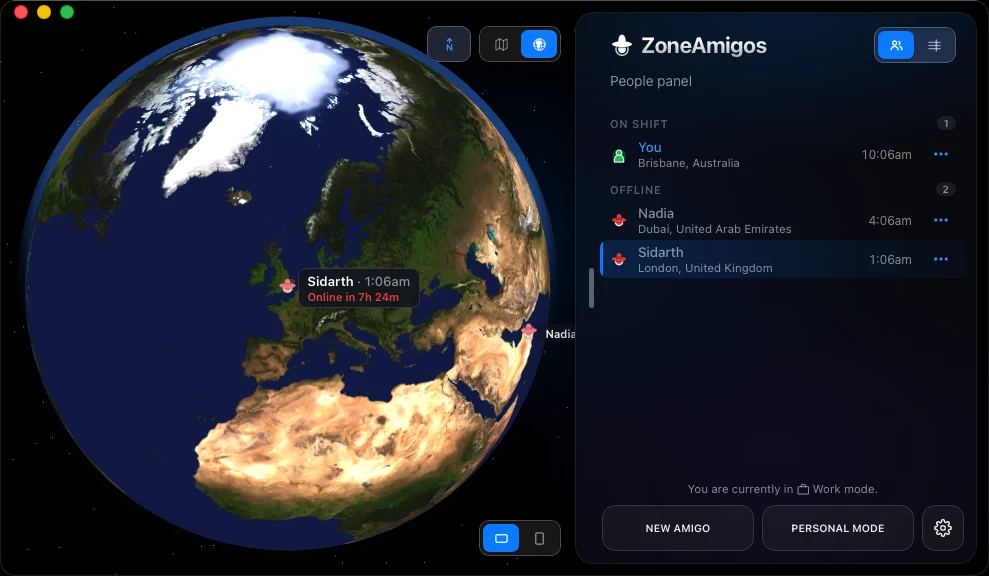
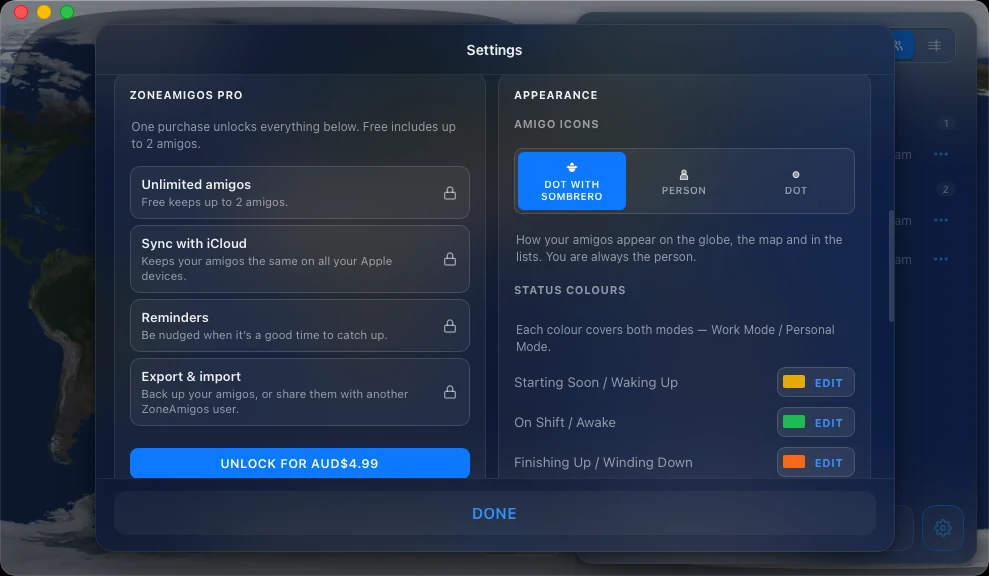
Give people working across global teams, or with family and friends abroad, a real feel for where everyone is and what the time is for them: who is likely at work, who is winding down, who is asleep. Finding a good window to reach someone becomes a glance at a globe rather than timezone arithmetic — and a reminder can be set for that window, so the call or the message does not get forgotten.
Description
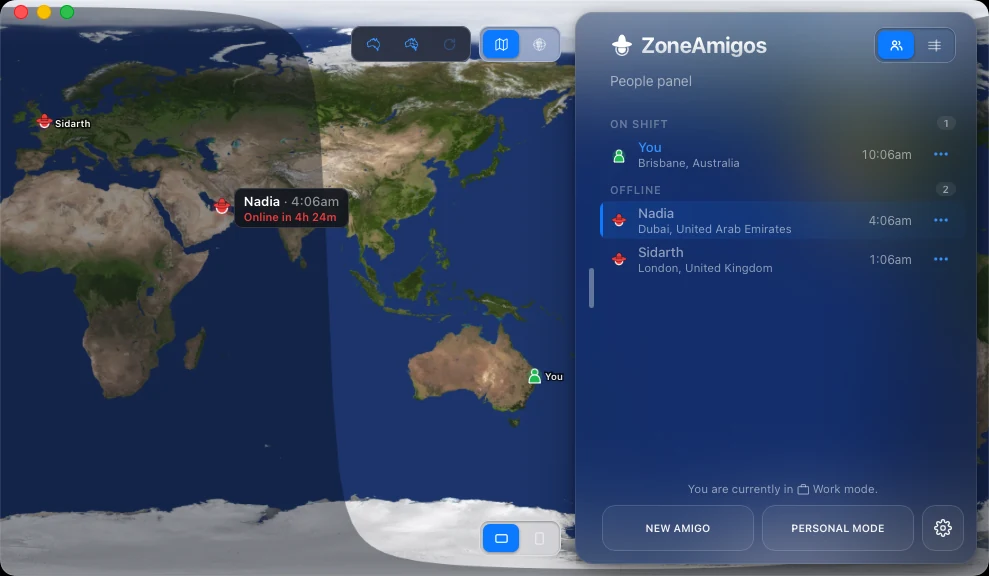
A contact timezone visualiser built to solve a gap that presence tools like Teams or Slack do not cover: an “online” indicator shows whether someone’s device is active, not whether it is an appropriate time to reach them. Two view modes show where everyone is — a spinning globe, or a flat map that slides left and right — and a people panel handles adding contacts, setting reminders, and removing them.
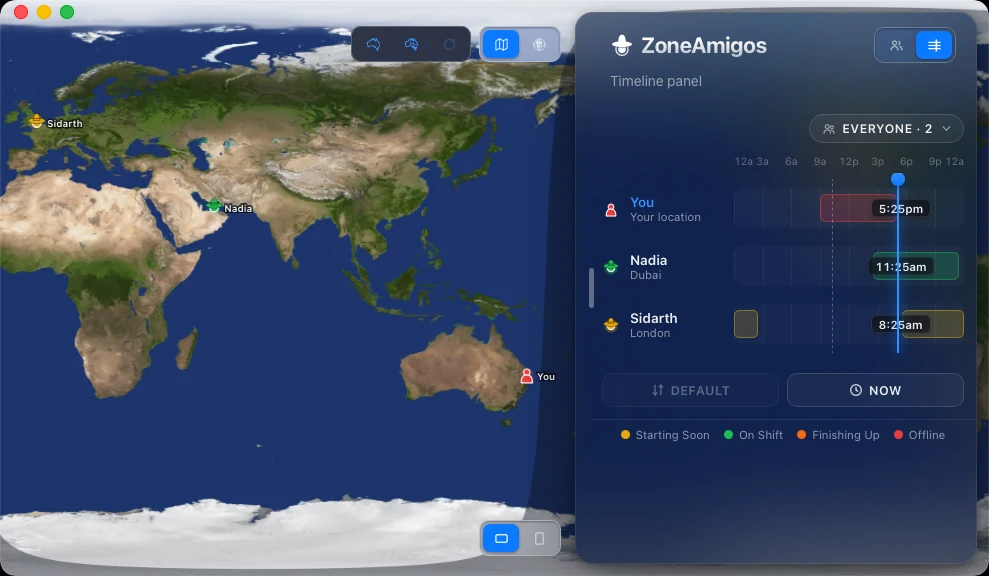
The second half of the app is a timeline. Drag time forwards or backwards and overlapping hours surface through colour cues alongside plain time labels, so finding a window that works for three cities is a slider rather than arithmetic. Contacts hold nothing private: a name or nickname and a city. There are no accounts, no analytics and no server behind it — everything lives in the browser’s local storage, and the only thing that ever leaves is the licence key, sent to Lemon Squeezy to confirm it is valid. Privacy here is a property of the architecture rather than a promise in a policy.
Free for up to two contacts. A one-time unlock adds unlimited contacts, reminders and alerts, and an import/export function for backing up a list, moving it between devices, or sharing one across a team. It is sold as a licence key through Lemon Squeezy under Canino Digital, validated in-app against the Lemon Squeezy licence API, and good for up to five browsers.
Technology / tools
A web app that runs in the browser on any platform, with a native build heading for the App Store. Built with React and Vite. The globe is a hand-written Three.js and WebGL scene with custom GLSL shaders driving a live day–night terminator calculated from real solar position; the flat map is rendered as SVG with d3-geo. There is no backend: contacts, reminders and preferences live in browser storage, and a licence check against the Lemon Squeezy licence API is the only network call the app makes. The iPhone and Mac builds add optional iCloud sync through the user’s own Apple ID. Built entirely through AI-directed development using Claude Code.
Eliminate the admin burden of manually managing 3 properties across 2 booking platforms — 6 separate calendars and listings to keep synchronised — by centralising everything into one automated system, while adding a direct-booking channel that bypasses third-party platform fees entirely.
Description
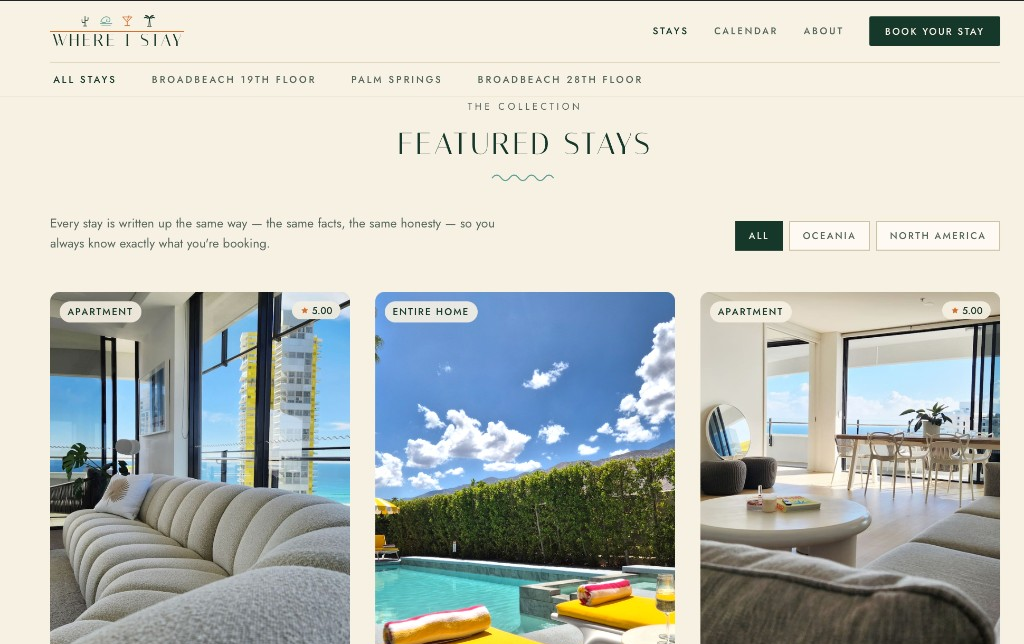
Researched and recommended an existing channel-management platform as the centralised backend to consolidate a host’s growing short-stay portfolio — 3 properties, 6 individually-managed calendars and listings across Airbnb and Booking.com — into a single source of truth for availability, descriptions, and photos.
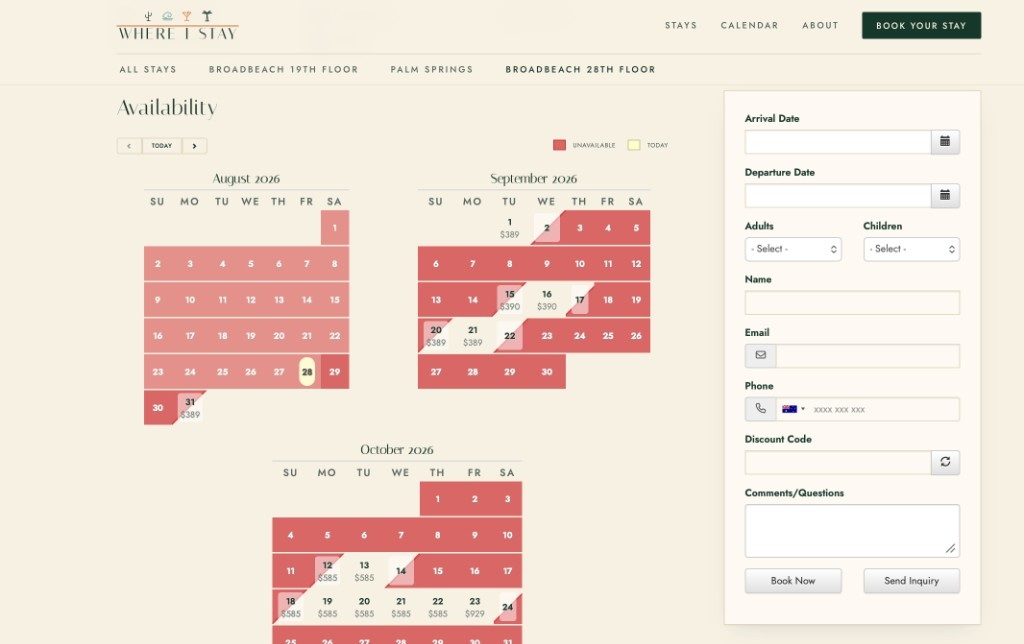
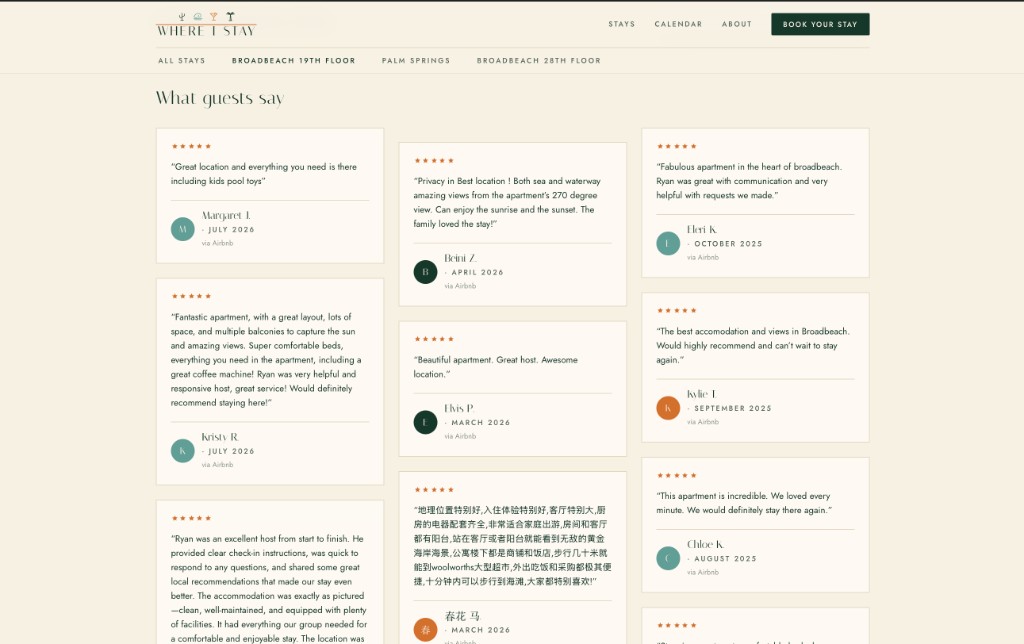
Then designed and built whereistay.co, a custom, sleek direct-booking website to sit on top of that backend as a dedicated channel for returning guests, family, and friends — separate from the discovery-driven traffic on Airbnb and Booking.com. The site pulls property details, photos, and guest reviews automatically from the backend via a scoped, read-only API integration — no manual re-entry, ever.
Outcome
The host now manages 100% of bookings, listings, and guest communication from one platform, with a book-direct channel that lets repeat guests, family, and friends bypass third-party platform fees entirely.
Technology / tools
Frontend React 18 and TypeScript, built with Vite; Tailwind CSS for styling.
Content sync Custom build-time integration with the backend platform’s REST API — pulls listing content and reviews automatically on every deploy, with graceful fallback to last-known-good content if the API is unavailable.
Hosting / deployment Vercel, with automatic preview deployments per change and long-term asset caching.
Booking engine Embedded booking widgets — availability calendars and the direct booking form — from the backend platform.
Architecture Fully static site with no custom backend or server infrastructure; all dynamic content is resolved at build time or delegated to the platform’s widgets.
Privacy by design Contact details are encoded and only revealed on user interaction, reducing exposure to scraping bots. Guest avatars are generated from initials rather than fabricated photos, since no photo data exists upstream.
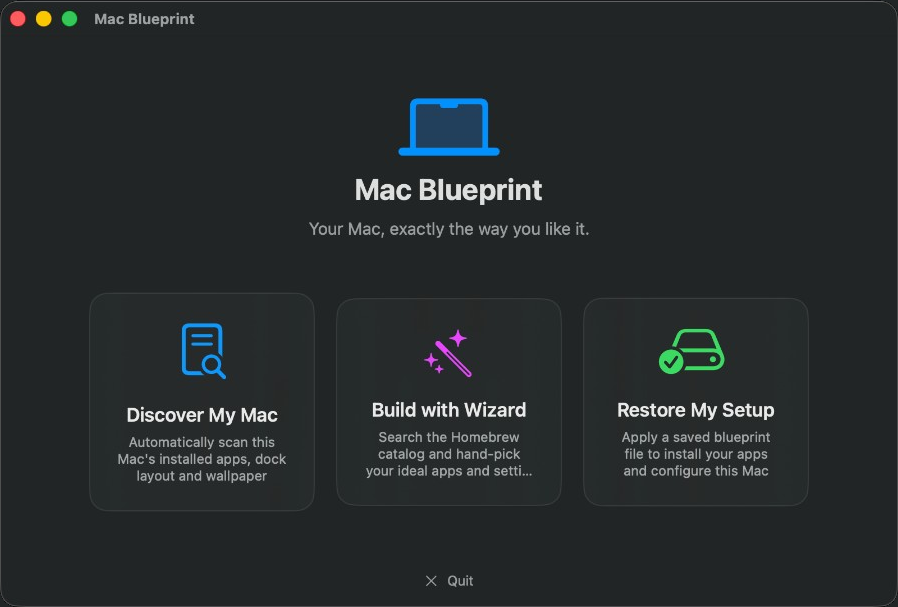
Capture a known-good Mac configuration and restore it onto a new or reset machine in minutes, without standing up an MDM.
Description
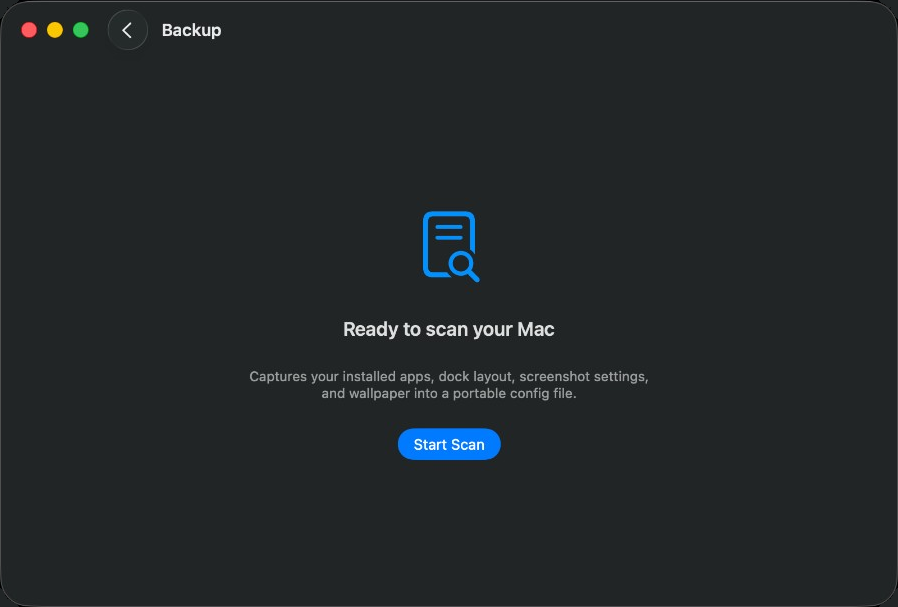
A native macOS app that solves two related problems: bringing MDM-less environments — small businesses, schools — to a fast, consistent baseline, and restoring an individual’s personal setup such as dock layout, shortcuts, and wallpaper, which most MDMs do not manage even when one is in place.
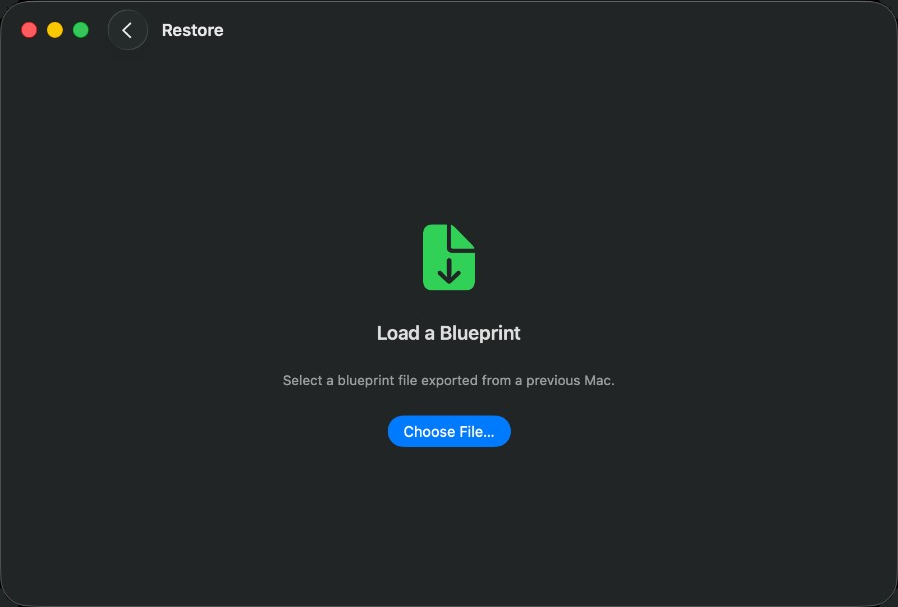
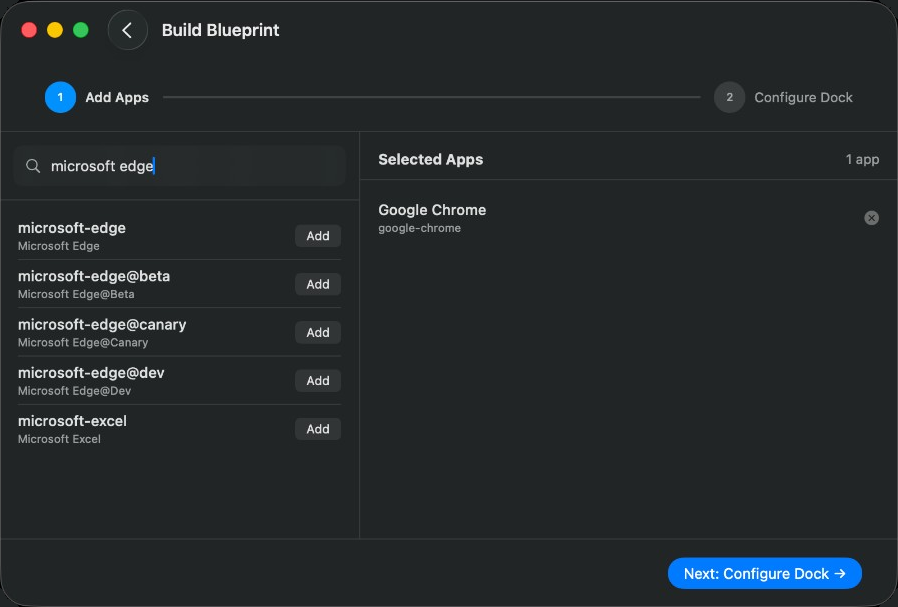
The app scans an existing Mac and captures its configuration — manually installed apps, full dock layout and folder structure, screenshot preferences, wallpaper, and detected signed-in accounts — into a self-contained JSON file, or builds one from scratch via a guided wizard that lets a user hand-pick apps from Homebrew and design a dock layout independently of any existing machine. On a freshly reset Mac, importing that file drives an automated install and restore sequence: Homebrew formulae, casks, and App Store apps are installed, the dock is cleared and rebuilt to match, and wallpaper is reapplied — cutting what was previously up to an hour of manual setup down to a guided, largely automatic process. Sign-ins are deliberately left manual — the app detects only email addresses, never credentials, and walks the user through re-authenticating each service — rather than automated, to avoid handling sensitive credentials.
Technology / tools
Native Swift / SwiftUI application — not a script or shell wrapper — built with Xcode, using Apple’s first-party frameworks throughout: AppKit for wallpaper and display handling, Foundation for process orchestration, and Swift’s modern concurrency (async/await) to coordinate installs without blocking the UI. Integrates with Homebrew, the Mac App Store CLI, and dockutil for dock reconstruction. Configuration is captured as human-readable, diff-stable JSON. Built entirely through AI-directed development using Claude Code, which used Xcode tooling directly to build and iterate on the native app.
I am looking for a role helping organisations adopt AI into day-to-day operations. Brisbane based, open to relocating to Sydney. Email is the fastest path; the CV is a click away.
Technology is what I actually enjoy — the gadgets, the tools, and the systems that hold them together.
If you are bringing in something new and there is no in-house expert for it yet — a platform, a vendor product, an AI toolchain — that gap is the part of the job I like most.
If you are hiring, I am glad to meet for a coffee and talk it through: what you are trying to solve, what I have done, and whether the two line up.